I’ve been thinking about something that might make some people uncomfortable, particularly those who believe questioning certain Jewish traditions is itself a threat to Judaism.
What if God’s promise to Ishmael appears, at least in terms of numbers, to have been fulfilled more visibly than His promise to Jacob?
I know that’s a provocative question. I’m Jewish, I believe in the importance of our traditions, and I don’t pretend to be a rabbi or a scholar of Jewish law. Yet the more I think about Jewish history, our population, and the challenges we face today, the more I wonder whether we’ve made it unnecessarily difficult for people to become part of the Jewish people.
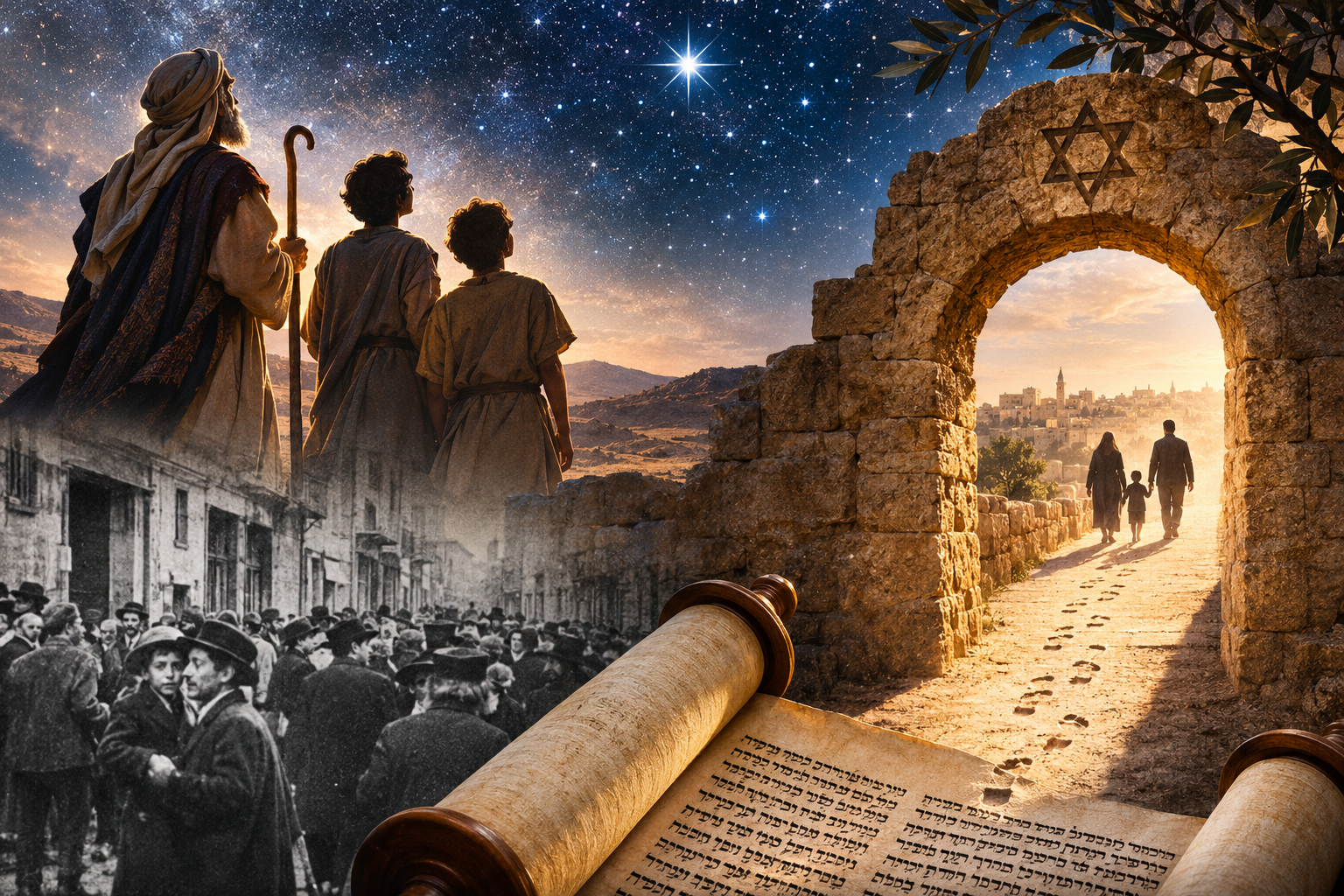
In Genesis, particularly in the weekly Torah portions we’ve read over the past few weeks, God promises Abraham that his descendants will be as numerous as the stars in the heavens and the sand along the seashore:
כִּי-בָרֵךְ אֲבָרֶכְךָ, וְהַרְבָּה אַרְבֶּה אֶת-זַרְעֲךָ כְּכוֹכְבֵי הַשָּׁמַיִם, וְכַחוֹל, אֲשֶׁר עַל-שְׂפַת הַיָּם
Ishmael, Abraham’s son through Hagar, receives his own promise. God tells Abraham that Ishmael will become a great nation and that twelve princes will descend from him:
וּלְיִשְׁמָעֵאל, שְׁמַעְתִּיךָ–הִנֵּה בֵּרַכְתִּי אֹתוֹ וְהִפְרֵיתִי אֹתוֹ וְהִרְבֵּיתִי אֹתוֹ, בִּמְאֹד מְאֹד: שְׁנֵים-עָשָׂר נְשִׂיאִם יוֹלִיד, וּנְתַתִּיו לְגוֹי גָּדוֹל
Jacob, later renamed Israel, receives a similar promise. His descendants will spread in every direction, becoming a great multitude. These promises are central to our understanding of who we are and where we came from.
Yet look at the world today.
There are fewer than sixteen million Jews worldwide. Before the Holocaust, there were approximately 16.6 million. More than eighty years after the murder of six million Jews, we still haven’t recovered the population we had before World War II.
Christianity has approximately 2.3 billion adherents worldwide. Islam has approximately two billion. Both religions have expanded across continents, cultures, languages, and ethnicities.
Of course, not all Muslims are biological descendants of Ishmael, nor are Christians necessarily descended from a particular biblical family. Religion and ancestry aren’t the same thing. The same is true of Judaism. Children of converts, adopted children who convert, and adults who convert are all just as Jewish as those who can trace their ancestry back generations.
We’ve always had a way for people to become part of the Jewish people without being born into it.
So why have we made that path so difficult, particularly when our numbers remain so small?
I’m not suggesting that biblical promises should be measured by a modern census. Judaism, Christianity, and Islam understand Abraham’s legacy differently, and the Jewish people are not simply a religious population comparable to the worldwide membership of Christianity or Islam.
Still, the contrast is extraordinary, and I think it’s worth examining rather than dismissing.
How Christianity Opened Its Doors
A historical irony makes this question even more interesting.
Christianity emerged from within Judaism, not as a separate religion. Jesus and his earliest followers were Jews who practiced Jewish traditions, observed Jewish law, and understood their beliefs within the religious framework of their time.
First-century Judaism was hardly uniform. There were Pharisees, Sadducees, Essenes, and other movements with competing interpretations of Jewish law, religious authority, and messianic expectations. The earliest followers of Jesus were part of that world. They believed he was the Messiah, but they didn’t initially understand themselves as members of an entirely separate religion.
The separation between Judaism and Christianity developed over generations, influenced by theological disagreements, Roman political decisions, the destruction of the Second Temple, and the gradual establishment of distinct religious institutions.
One of the most consequential developments, however, came early.
The followers of Jesus faced a fundamental question: Could non-Jews join their movement without first becoming Jewish?
Paul, himself a Jew, argued that they could.
Gentiles wouldn’t need to undergo circumcision or accept the full obligations of Jewish law to become followers of Jesus. The dispute became so significant that early Christian leaders addressed it in Jerusalem around the middle of the first century.
Think about what that meant. A movement that began among Jews was opening itself to the wider world, welcoming people who believed in the God of Israel without requiring them to become Jewish or accept every obligation of Jewish law.
I will be called a heretic for even asking the question, but I’ve been wondering whether we’ve been looking at that moment in history the wrong way. We generally see the emergence of Christianity as the beginning of a separation, when a movement born within Judaism eventually became a different religion. Yet what if it also offered Judaism an opportunity to become something much larger?
What if, rather than allowing that movement to develop outside Judaism, there had been a way to welcome those Gentiles into a broader Jewish religious community? Not necessarily by abandoning Jewish law or accepting theological beliefs that contradicted it, but by finding a place for people who wanted to worship the God of Israel without becoming Jews in the traditional sense.
Would Judaism have developed differently? Would the Jewish people have remained such a small population? Could the promise to Abraham that his descendants would be as numerous as the stars in the heavens and the sand along the seashore have been understood more broadly?
I don’t know the answers. Christianity’s separation from Judaism involved much more than conversion requirements, and there’s no reason to assume that a different approach would have prevented that separation.
Still, I wonder whether we’ve spent so much of our history protecting Judaism’s boundaries that we haven’t always recognized opportunities to expand its reach. Perhaps the question isn’t simply why Christianity grew while Judaism remained small, but whether Judaism could have welcomed more people without losing what made it Judaism.
The separation between the religions was far from complete. Jewish followers of Jesus continued observing Jewish traditions, and some communities maintained connections to both religious worlds for centuries.
The Roman Empire also shaped how the two identities developed. After the destruction of the Second Temple in 70 CE, Rome imposed a special tax on Jews, known as the fiscus Judaicus. Its enforcement raised questions about who was legally considered Jewish, particularly when religious practices and identities overlapped.
Some historians argue that Roman tax policy helped push Jewish and Christian identities apart. Others place greater emphasis on theological disputes, communal developments, and the political consequences of the Jewish revolts against Rome. Whatever weight one assigns to those factors, the separation wasn’t a single event. It was a long process.
Christianity eventually gained imperial support and became the official religion of the Roman Empire. Its subsequent expansion involved missionary activity, political power, cultural influence, and, at times, coercion and forced conversion.
I wouldn’t pretend that Christianity grew to billions simply because Paul made it easier for Gentiles to join. Yet removing the requirement that non-Jews first become Jewish was an important development. It allowed the movement to reach populations that might never have accepted the full obligations of Jewish religious life.
Judaism continued along a different path.
Becoming Jewish meant more than accepting a particular set of beliefs. It meant joining a people, accepting a covenant, and assuming religious obligations that touched nearly every part of daily life.
I understand that distinction. I don’t think it should disappear.
Yet looking at the world today, with antisemitism and hatred of Jews becoming increasingly visible, I wonder whether we’ve become so concerned with protecting the boundaries of Jewish identity that we’ve neglected opportunities to welcome more people into the Jewish community and strengthen our future.
A religious movement that emerged from Judaism eventually grew to billions of adherents, while the Jewish people themselves remain fewer than sixteen million.
I’m not suggesting we abandon Jewish law, or turn Judaism into a missionary religion. I am asking whether there’s something to learn from the different ways these two religious communities developed.
The question isn’t whether someone born outside the Jewish people can become one of us. It’s whether we’ve made that process more difficult than it needs to be, and whether the consequences extend beyond the individuals we’ve discouraged from joining.
Why Numbers Matter, Even When They Don’t Guarantee Safety
Numbers matter. They matter in politics, international relations, education, business, and in communities’ ability to protect their interests.
That doesn’t mean a larger population is automatically more powerful or more secure. History provides plenty of examples to the contrary. Still, it would be foolish to pretend that population size has no consequences.
Consider the influence Christianity and Islam have on the countries and societies in which they are dominant. Their populations shape political debates, cultural expectations, laws, public institutions, and international relationships.
Jewish communities, by contrast, are minorities almost everywhere outside Israel.
We have achieved extraordinary things despite our numbers, and Jewish influence in certain fields is undeniable. Yet influence isn’t the same as security, and prominence isn’t the same as political strength.
We’ve learned repeatedly that economic success, education, cultural integration, and even political influence don’t necessarily protect Jews when a society turns against them.
In democratic societies, population size can translate into electoral influence. Communities that organize effectively can shape public policy, and political leaders respond to constituencies. Jews have long understood this. We’ve built institutions, advocacy organizations, schools, charities, and political relationships to protect our communities.
Yet we remain a very small population, and we’re hardly united. We disagree over religion, Israel, Zionism, politics, and what Jewish identity should mean. Some Jews oppose Zionism or particular Israeli government policies, while others oppose religious restrictions and practices. These disagreements are sometimes fundamental, and they can make it harder to speak collectively about threats to Jewish life.
I don’t believe the solution is to demand uniformity. Jewish disagreement is practically a tradition in its own right. Still, I believe we should take our demographic vulnerability more seriously.
What Happens When Jewish Communities Disappear?
Look at what happened to Jewish communities across the Middle East and North Africa.
For centuries, Jews lived in Iraq, Egypt, Yemen, Libya, Syria, Algeria, Morocco, Tunisia, and other countries across the region. Some of those communities were ancient, predating Christianity and Islam.
Jewish life in Iraq, for example, stretched back to the Babylonian exile. Its scholars helped produce the Babylonian Talmud, one of the foundational texts of Jewish religious life.
These weren’t temporary communities of people passing through. They were deeply rooted populations with synagogues, schools, businesses, religious institutions, and traditions developed over generations.
Around the time Israel was established, approximately 850,000 Jews lived in Arab countries. Over the following decades, the overwhelming majority left. Some fled violence and persecution. Others faced discriminatory laws, confiscation of property, political pressure, expulsion, and deadly massacres. Some emigrated because they wanted to build new lives in Israel or elsewhere. The result is undeniable.
Jewish communities that had existed for hundreds or even thousands of years were reduced to a fraction of their former populations, and in some countries virtually disappeared.
Think about what that means.
Generations of Jewish history, culture, religious practice, and family life were uprooted. Synagogues emptied. Schools closed. Cemeteries were left behind. Communities that had once been integral parts of their societies ceased to exist as living Jewish populations.
When Jews and Israel are accused of genocide, and Jews are portrayed as colonizers in discussions about the Palestinians, this history is often conveniently left out of the conversation.
The displacement of approximately 700,000 Palestinian Arabs during the 1948 war is rightly part of any serious discussion of the conflict. Yet the displacement of hundreds of thousands of Jews from Arab countries is also part of the region’s history.
Recognizing one doesn’t erase the other. Both histories deserve to be acknowledged. The displacement of Jewish communities that had existed across the Middle East and North Africa for centuries shouldn’t be ignored, nor should the thousands of years of continuous Jewish presence in the land of Israel, long before the establishment of the modern state.
My recent trip to Poland brought these questions much closer to home. Before World War II, Poland was home to approximately 3.3 million Jews, about ten percent of its population and one of the largest Jewish communities in the world. Warsaw alone had a Jewish population representing roughly a third of the city.
I walked through places where Jewish families had lived, prayed, raised children, and built communities. These were people with ordinary lives, hopes, ambitions, arguments, and plans for the future. Then entire communities were murdered.
Standing there, I kept thinking about how completely a population can disappear.
Of course, numbers alone didn’t protect Polish Jewry. Three million Jews couldn’t withstand Nazi Germany’s systematic campaign of extermination. Nor did centuries of Jewish history in Poland guarantee that Jewish life would continue there.
There’s another uncomfortable part of that history.
Some assimilated German Jews looked down on their Eastern European counterparts, considering themselves more educated, cultured, and sophisticated than the Jews of the shtetls. They believed their place in German society distinguished them from those other Jews.
The Nazis made no such distinction. To them, a German Jew was no different from a Polish Jew. That’s a lesson Jews across the religious, cultural, and political spectrum, including Bernie Sanders and George Soros, would do well to remember. Whatever our differences, those who hate Jews rarely care about the distinctions we make among ourselves.
That history reminds me that population size is only part of the question. We also have to consider how we treat one another.
We’ve spent generations dividing ourselves into categories, deciding whose Judaism is more authentic, whose traditions are more respectable, and whose religious practices deserve recognition.
We argue over who is Jewish enough to marry, worship, or belong within our communities. Even among Jews, there are families, including some within the Sephardic and Mizrachi communities, who discourage their children from marrying Ashkenazi Jews, much less converts. We have enough people questioning our right to exist without creating additional barriers among ourselves.
If we want to grow as a people, perhaps we should consider how often we’ve made ourselves smaller through our own divisions.
The Threats Haven’t Disappeared
I worry about what happens when small Jewish communities find themselves confronting much larger populations in countries where antisemitism is growing. I also worry about radical Islamist movements that openly advocate the subjugation, persecution, or killing of people who don’t share their beliefs.
There are extremist movements within Islam whose objectives are unmistakable. Their hostility extends beyond Jews to Christians, other religious minorities, secular Muslims, and Muslims who reject their interpretations of Islam.
Their numbers don’t have to represent anything close to a majority of the world’s Muslims to constitute a serious threat. When a religion has approximately two billion adherents, even a small extremist minority can represent millions of people.
The actual size of that minority is difficult to establish, yet the danger posed by violent extremist movements is real. Religious persecution continues across parts of Africa, Asia, and the Middle East, where jihadist organizations have attacked, displaced, and murdered Christians and other religious minorities.
I don’t have to wonder whether European governments have become reluctant to confront certain forms of religious extremism because of domestic political pressures, concerns about social unrest, or fear of appearing intolerant. We’ve seen what happens when democratic governments fail to confront extremism and protect Jews, Christians, and others who are threatened by it. Whatever the political considerations, the consequences of inaction are real.
Recent developments in the United States raise their own questions.
A September 2026 Rasmussen Reports survey found that 43% of likely voters ages 18 to 24 held a positive view of Islamic sharia law, while 27% of voters under 30 supported allowing an American community to adopt it as its legal code if a majority favored doing so.
The reported willingness of some younger Americans to let religious law govern a community deserves attention, especially when constitutional protections must apply equally to everyone.
Also, the threat to Jewish communities doesn’t come from one religious or political direction.
In November 2026, a British-born Christian cleric named Calvin Robinson openly called for driving Jews out of America, arguing that the country belonged to Christians.
Think about that. A religious leader living in a country built on constitutional protections for religious freedom was advocating the expulsion of an entire community because it didn’t belong to his religion.
American Jews have been part of this country since before its independence. Jewish immigrants helped build its institutions, economy, and civic life. Haym Salomon, a Jewish immigrant from Poland, played an important role in financing the American Revolution. Yet more than two centuries later, another immigrant was publicly suggesting that American Jews should leave.
The irony is extraordinary, but the larger point is more troubling.
Jews shouldn’t have to prove that their ancestors helped establish a country to justify their right to live there. Citizenship and religious freedom aren’t supposed to depend on belonging to the majority faith.
These are very different developments, but they remind me how easily religious identity can become a question of political power and belonging.
Jews have lived through enough history to understand what happens when other people begin deciding whether we have a right to remain in the societies we helped build.
With fewer than sixteen million Jews worldwide, it behooves us to consider whether we should be doing more to strengthen and grow our own communities.
Which brings me back to the question at the heart of this essay.
Who Gets to Decide Who Is Jewish?
Under traditional Jewish law, a person born to a Jewish mother is Jewish. Someone whose mother isn’t Jewish generally must undergo conversion to be recognized as Jewish, even if the father is Jewish.
That rule is deeply established in rabbinic Judaism. Yet the Hebrew Bible presents a more complicated picture of ancestry and identity.
Tribal affiliation, inheritance, and priestly lineage generally passed through fathers. Biblical narratives also include marriages to women from outside Israel and accounts of people joining the Israelite community. Ruth, a Moabite woman who embraced the people of Israel and their God, became the great-grandmother of King David. That makes her an ancestor of the Davidic line from which, according to Jewish tradition, the Messiah (Moshiach) is expected to descend. One of the most important lineages in Jewish history, therefore, traces back to a woman who chose to join the Jewish people rather than being born into them.
Historians debate how the rabbinic rule on matrilineal descent developed, while traditional Jewish authorities understand it as grounded in Torah law. I’m not attempting to resolve that debate. What interests me is how the rule affects Jewish life today.
Why should a child with a Jewish father, raised in a Jewish home, educated in Jewish schools, observing Jewish holidays, and identifying entirely as Jewish be told that he or she isn’t Jewish?
Imagine growing up believing you belong to the Jewish people, only to discover that a religious authority doesn’t recognize you because your mother wasn’t Jewish. What exactly are we protecting in that situation?
I know the traditional answer. Jewish identity isn’t determined solely by personal feelings, family upbringing, or genetic ancestry. Halacha establishes religious status according to its own rules.
I respect that explanation even as I question its consequences.
Reform Judaism in the United States has recognized certain children of Jewish fathers as Jewish since 1983, provided they are raised Jewish and meet its requirements for affirmative identification with Judaism.
Orthodox and Conservative Judaism have not adopted that approach. As a result, someone can be recognized as Jewish in one community and not in another. That creates real problems for families, marriages, religious participation, and the broader question of Jewish unity.
We also live in a world where DNA testing can identify biological relationships and provide information about ancestry with a degree of precision unimaginable to previous generations.
That doesn’t mean DNA can establish halachic Jewish status. It cannot. Nor can a genetic test reliably prove an unbroken line of descent from Abraham. Still, modern science does make some of our conversations about ancestry more interesting.
If we can establish that someone’s father is Jewish, and that person has been raised Jewish, why should maternal ancestry be the only path to recognition apart from conversion?
I understand that religious law doesn’t change simply because science advances. Yet Jewish scholars are already debating whether meat grown in a laboratory should be considered meat under the laws of kashrut, including whether it can be eaten with dairy. If scientific developments can prompt serious discussions about how we interpret and apply Jewish law, shouldn’t questions about Jewish ancestry and identity deserve the same thoughtful consideration rather than automatic dismissal?
There’s another aspect of this that has bothered me for some time.
A person born to a Jewish mother is Jewish under traditional Jewish law, regardless of how that person lives. He can reject Judaism, never enter a synagogue, eat whatever he wants, ignore Shabbat, marry outside the faith, and declare himself an atheist.
Yet he remains Jewish.
A woman born to a Jewish mother can do exactly the same things. She remains Jewish.
Neither has to demonstrate knowledge of Jewish history, religious commitment, observance, or belief in God to retain Jewish status.
Now consider someone who wasn’t born Jewish but genuinely wants to become Jewish. That person may face an extended period of study, religious instruction, lifestyle changes, and examination of personal commitment.
An Orthodox conversion generally requires acceptance of the obligations of Jewish law, including Shabbat, kashrut, and other religious practices.
There’s a reason for that. Judaism isn’t simply a club someone joins by filling out an application. Becoming Jewish carries religious meaning and communal responsibilities. Yet there’s something difficult to reconcile.
A person who was born Jewish can disregard nearly every religious obligation and remain Jewish. Someone who wasn’t born Jewish may be required to demonstrate a level of commitment that many Jews by birth have never practiced and have no intention of practicing.
Why?
I know the halachic explanation: Jewish status by birth and the requirements for entering the covenant through conversion are different legal categories. That explains the distinction within Jewish law.
It doesn’t eliminate the question of whether the disparity makes sense for the future of the Jewish people.
I’m not advocating conversions that require nothing more than a declaration of interest. I am asking whether we’ve created expectations for prospective Jews that we would never impose on Jews who happened to be born to the right mother.
If someone sincerely wants to join the Jewish people, raise Jewish children, celebrate our holidays, participate in Jewish communal life, and share our future, shouldn’t we be looking for responsible ways to welcome that person?
Judaism Has Changed Before Without Ceasing to Be Judaism
Judaism has survived partly because it learned to adapt. When the First Temple was destroyed and Jews were exiled to Babylon, Jewish life continued outside the land of Israel.
When the Romans destroyed the Second Temple in 70 CE, Judaism faced another extraordinary challenge. The Temple had been the center of Jewish religious life. Sacrifices, priestly service, and pilgrimage were central to its practice.
With the Temple gone, the rabbis helped establish a religious life increasingly organized around prayer, Torah study, Jewish law, and communal institutions. Judaism survived without the institution that had once stood at the center of its worship.
A religion whose sacred practices had been closely connected to a particular place developed ways to maintain its identity across countries and continents.
The Torah, the Mishnah, the Talmud, and the traditions that grew around them helped connect Jewish communities separated by thousands of miles.
That didn’t happen because Jews abandoned their religion. Jewish religious life developed in response to circumstances that could otherwise have threatened its survival.
I find that history remarkable, particularly when I hear arguments that even discussing changes to how we recognize Jewish identity or welcome converts somehow threatens Judaism.
The broad lesson here is that Judaism maintained its identity while finding ways to live under dramatically changed circumstances.
Perhaps we should be asking whether the challenges facing the Jewish people today require us to think just as seriously about our future.
For centuries, our concern was how to preserve Jewish life when we had no state, when communities were scattered, and when persecution could destroy generations of Jewish families.
Today, we have Israel, strong Jewish institutions, access to education, and opportunities to practice Judaism openly in many countries. Yet our worldwide population remains smaller than it was before the Holocaust.
We spend enormous amounts of time discussing assimilation, intermarriage, declining religious observance, antisemitism, and the challenges of Jewish continuity, and they are legitimate concerns.
Yet how often do we seriously discuss growing the Jewish population?
Not merely preventing Jews from leaving the community, but welcoming people who genuinely want to join it.
We worry about losing Jews through intermarriage. Yet when a Jewish man marries a non-Jewish woman, and they raise children who identify as Jewish, many Jewish institutions refuse to recognize those children as Jews unless they undergo a difficult conversion.
We worry about declining participation. Yet people who want to become Jewish sometimes encounter a process that feels designed to test how badly they want to belong rather than help them find a place within the community.
We worry about antisemitism. Yet we rarely discuss whether having a larger Jewish population might strengthen our communities politically, culturally, and institutionally.
Of course, a larger population wouldn’t eliminate antisemitism. Hatred of Jews has existed in societies where Jews were numerous and where Jews were almost nonexistent. Antisemitism is not a consequence of Jews failing to produce enough children or attract enough converts. Still, numbers matter.
A larger Jewish population could mean more families, more communities, more schools, more institutions, and more people with a personal stake in the Jewish future.
It could also mean a broader range of Jewish experiences, traditions, and perspectives.
Growth wouldn’t solve every problem, and poorly considered changes could create new divisions over religious recognition and communal identity.
Those risks should be part of a serious discussion, not a reason to avoid having one. We cannot spend centuries making it difficult for people to join us and then act surprised that so few people understand us, or worse, resent us for what they perceive as our success and exclusivity. Perhaps we should be asking whether the barriers we’ve built to preserve Jewish identity have also contributed to keeping the Jewish people so small, leaving us more vulnerable to hatred, attacks, and marginalization.
I think about this differently now than I might have twenty or thirty years ago.
I’ve watched my children grow up. I have grandchildren. I think about the world they’re inheriting and what Jewish life will look like for their children and grandchildren.
My recent trip to Poland, and my other visits to places in Europe where Jews used to live, made those questions feel more immediate.
I walked through places where Jewish families had once lived ordinary lives. They worked, studied, prayed, argued, fell in love, married, and raised children. They had plans for the future, just as we do, until entire communities were murdered.
Standing there, it was impossible not to think about the generations that never came into existence.
The children who were killed would have grown up. Some would have married and had children of their own. Those children might have had families, and those families might have produced still more generations.
The Holocaust didn’t only murder six million people. It also destroyed the futures they might have created.
We can’t recover those lives. We can, however, think seriously about what it means to build the Jewish future.
I don’t believe Jewish identity to be defined only by the people who tried to destroy us. Our history includes extraordinary suffering, but it also includes intellectual achievement, religious scholarship, science, medicine, literature, music, family, humor, argument, and an enduring attachment to a people and a land.
There’s something wonderful about being Jewish that deserves to be shared. That doesn’t mean pressuring people to convert or measuring our success by how many people we persuade to join us.
Judaism has never made proselytizing a central mission. Our calling is to be a light unto the nations, to lead by example rather than demand that others believe as we do.
We don’t need the rest of the world to become Jewish to believe that Judaism has something valuable to offer it.
Still, some people already want to belong.
Some have Jewish fathers and have spent their entire lives identifying as Jews. Some are married to Jews and want to build Jewish homes. Others have no Jewish ancestry at all but find meaning in our history, beliefs, traditions, and communal life.
Why shouldn’t we be more interested in helping them become part of our future?
I recognize that traditional Jewish law places limits on what rabbis and religious authorities can change. Yet I also wonder whether we have the rabbinic leadership and collective will today to make the kind of bold decisions that earlier generations were willing to consider. Jewish history gave us towering figures such as Rabbeinu Gershom, Maimonides, and, more recently, Rabbi Moshe Feinstein, whose scholarship and rulings influenced Jewish communities far beyond their own. They didn’t always agree with their contemporaries, and their decisions weren’t universally accepted, but they had the stature to address difficult questions and help shape Jewish practice for generations.
Today, religious authority seems far more fragmented. Every community, sometimes seemingly every neighborhood or even every block, has its own rabbi and its own interpretation of what is acceptable. We still have great scholars, but Ii am not sure any one of them could bring enough of the Jewish world together to reconsider something as fundamental as conversion and Jewish identity.
I don’t pretend to have the religious expertise to resolve those questions. I do believe we need leaders willing to ask them, rather than simply explain why nothing can change.
I also recognize that Jews who follow different religious movements won’t necessarily agree on what constitutes a valid conversion or who should be recognized as Jewish.
Those disagreements are real.
Yet Jewish history is filled with difficult questions that our ancestors had to confront. The destruction of the Temple forced a reconsideration of how Jewish religious life could continue. Exile forced Jewish communities to maintain their identity far from Jerusalem. Modernity forced Jews to reconsider their relationship with the societies around them. The establishment of Israel transformed Jewish political and national life.
Perhaps our generation needs to confront another question.
How do we preserve the religious and cultural identity of the Jewish people while creating more opportunities for people to become part of it?
I return to the promises made to Abraham, Ishmael, and Jacob.
I do not know exactly how to understand or measure those promises. I do know that the Jewish people have survived circumstances that destroyed countless other ancient peoples, and by every standard, that survival is extraordinary. Yet survival and growth aren’t the same thing.
For much of our history, simply remaining Jewish was an achievement. Our ancestors preserved Jewish life despite enormous pressure to abandon it. We owe them something more than gratitude. We owe them a future.
That means protecting Jewish communities, strengthening Jewish education, supporting Israel, confronting antisemitism, and encouraging Jewish families to pass their traditions to the next generation.
I believe it should also mean taking a serious look at those standing outside our communities who genuinely want to come in.
We don’t have to abandon our traditions to question whether every barrier we’ve created is necessary, nor do we diminish what it means to be Jewish by welcoming more people into the Jewish people.
After everything we’ve experienced, perhaps it’s time to ask whether we should simply accept remaining such a small people, or whether God’s promise to Abraham was something we were meant to help fulfill.


Leave a Reply